QUESTION
From a PHYSICS standpoint, how do AG Tracks & Tires interact with the soil differently, why do Tracks have a different optimum slip compared to Tires, and what specific applications does each lend itself to perform best on?
Maxam Tire International
Trevor Wilson: Marketing Specialist
Tracks and tires move across soil differently at a fundamental physics level, and that difference determines which one belongs on your ag equipment. Understanding how each system generates traction, manages ground pressure, and responds to slip gives you the information to make that decision based on your operation rather than on assumption.
MAXAM’s Position in Both Categories
The honest answer for most farming operations is that neither tracks nor tires are uniquely superior. The right choice depends on soil type, seasonal moisture conditions, implement load requirements, and the proportion of your work cycle that involves road travel. In consistently wet, heavy soils where high-horsepower drawbar work is the primary task, tracks deliver a real physics-based advantage.
In mixed conditions with significant road travel and varying soil moisture, a properly specified VF radial tire running at optimized inflation pressure competes directly with tracks on soil protection and traction while cutting down on operating costs.
How Tires Interact with the Soil
A tire generates traction through a single, concentrated contact patch. The size of that patch is directly controlled by inflation pressure, tire size, and axle load. Lower inflation pressure increases sidewall deflection, which lengthens and widens the footprint. A larger footprint distributes the machine’s weight across more soil surface area, reducing ground pressure in pounds per square inch and improving flotation in soft conditions.
Traction depends on the interaction between the tread lug and the soil. As torque is applied, the lug shears into the soil surface. The soil resists that shear force, and the reaction pushes the machine forward. On firm ground, this system is highly efficient. On soft or wet ground, the soil shear strength is lower, meaning the lug breaks through the surface before the full reaction force is generated. The result is slip, which produces rutting, compaction below the disturbed layer, and wasted fuel.
How Tracks Interact with the Soil
A track distributes machine weight across a contact area determined by track width and the length of ground contact between the front idler and rear drive sprocket. This geometry produces a lower ground pressure than a tire of equivalent width on the same machine, because the load is spread over a much longer surface.
The traction mechanism for a track is different from a tire in one important way. Rather than relying on individual lug shear at a single contact patch, a track engages the soil across the entire length of its ground contact. The track links apply force progressively as the machine moves forward, distributing shear stress across a larger soil volume. This is why tracks maintain traction in conditions where a tire would spin out. The soil does not need to resist the full shear force at a single point. It only needs to resist a fraction of it at any given moment across the full track length.
There is an important qualifier here. Weight is not distributed evenly across a track’s contact patch. The rollers and idler wheels concentrate load at specific intervals along the track, creating localized pressure points that exceed the average ground pressure figure. In very soft or saturated soil, those concentrated points still cause subsurface compaction even when the overall average ground pressure appears low.
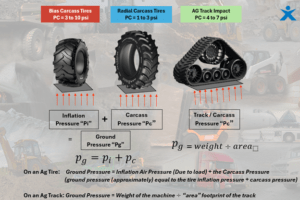
Slip is the difference between the theoretical distance a driven wheel or track should travel based on its rotation and the actual distance it travels over the ground. Some slip is necessary and normal. Zero slip means no traction force is being generated.
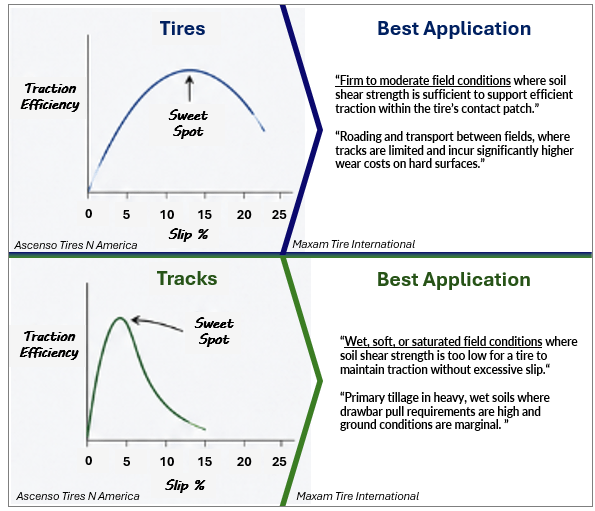
For a tire, optimum slip typically falls in the range of 8% to 15%. Below that range, the tire is not generating sufficient drawbar pull. Above it, the tread lug is breaking through the soil surface rather than pushing against it, and efficiency drops sharply while compaction increases. The tire’s contact patch is fixed in length at a given inflation pressure, so all the traction force must be generated within that footprint. When soil conditions are soft, the required torque to pull an implement exceeds what the soil can resist within that footprint before slippage occurs.
For a track, optimum slip is lower, typically in the range of 3% to 8%. The reason is the length of the contact patch. Because traction force is distributed across a longer ground contact zone, the track does not need to rely on any single section of that zone to generate the full drawbar pull. The soil shear resistance required per unit of contact area is lower, which means the system reaches its traction limit at a lower overall slip percentage. The track is generating the same total drawbar force as the tire but doing it more gradually across a longer surface.
What Applications Each System Performs Best In
The physics described above translate directly into application fit.
Tracks perform best in:
Wet, soft, or saturated field conditions where soil shear strength is too low for a tire to maintain traction without excessive slip. Primary tillage in heavy, wet soils where drawbar pull requirements are high and ground conditions are marginal. Operations where surface rutting is a significant concern and the field must remain passable throughout the season. High-horsepower row crop tractors pulling full implement loads in variable spring conditions where soil moisture changes across the field.
Tires perform best in:
Firm to moderate field conditions where soil shear strength is sufficient to support efficient traction within the tire’s contact patch. Roading and transport between fields, where tracks are limited and incur significantly higher wear costs on hard surfaces. Mixed operations that require both field work and road travel in the same day. Operations where operating cost is a primary constraint.
Modern VF (Very High Flexion) radial tires address the soft ground limitation more effectively than any previous tire technology. By operating at inflation pressures below 15 PSI while carrying full axle loads, VF tires create a contact patch that rivals what a track delivers in many field conditions. The sidewall does the work that air pressure previously handled, and the result is a longer, flatter footprint with significantly lower ground pressure than a standard radial or bias ply tire at equivalent load.
MAXAM is constantly developing new VF and standard tires sizes to not only complement our existing offer, but also to meet the evolving global demand for higher load, platform, or technological market changes. Soon MAXAM will be bringing Ag tracks to supplement our newly released construction track offer ensuring our innovative designs will exceed market expectations for load, speed, traction, and endurance.
Ascenso Tires North America
Robert Bender: Product Manager & Tech Support—Off-Highway Tires
Tires and tracks have the same basic job, transferring power to the ground while carrying and distributing the weight of the machine. They just go about it differently. Those differences impact everything from flotation and traction to ride quality, slip, fuel efficiency and roadability. Both systems have applications where they perform extremely well.
Tires are essentially flexible air chambers. The air pressure inside the tire carries the load while the casing flexes to create the footprint. A properly inflated radial or VF tire creates a longer footprint that helps spread the load while improving power transfer to the ground. That footprint becomes the contact patch responsible for both traction and weight distribution.
One of the biggest advantages tires have is flexibility. Tires absorb shock better in the field and on the road, generally ride smoother and allow for higher transport speeds when inflation pressures are correct. The biggest challenge with tires is often the simplest thing to change — air pressure. In reality, most farm tires are overinflated because pressures are rarely adjusted for changing loads, speeds or applications. That’s where I’m hopeful CTIS technology continues to help gain traction in agriculture.
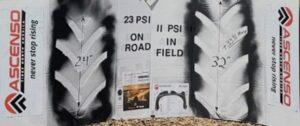
Central Tire Inflation System Example: 23 PSI to 11 PSI = 33% Larger Footprint
The flexibility of the casing and inflation pressure are two major components of the traction equation with tires. The third is lug penetration. Those three things together determine how efficiently the tire can pull through the soil. Tires rely on controlled slip to create traction, with an ideal operating range generally around 8%–15% slip and roughly 11% being near ideal. As a tire moves through the field it continuously creates a new footprint and new lug engagement with the soil.
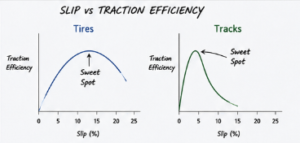
Tires vs Tracks Optimum Traction Efficiency
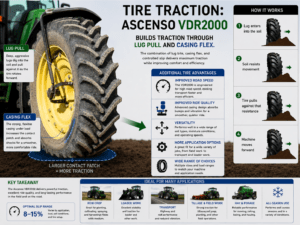
When one part of that system gets out of balance, efficiency drops quickly. An overinflated tire creates a smaller footprint. A smaller footprint reduces the number of lugs engaging the soil. Reduced lug engagement increases slip. Increased slip raises fuel consumption, reduces traction efficiency and increases the risk of both soil damage and tire damage.
Tracks work differently. They rely on a large consistent footprint to transfer power to the ground. With a track system the footprint is always there. As the machine moves, the track rolls over itself like a conveyor belt while maintaining a large contact patch. Because of that large footprint, tracks typically operate at much lower slip percentages, ideally somewhere in the 2%–5% range.
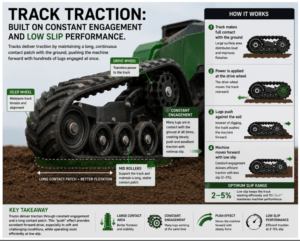
The same thing applies with tracks though, once slip moves outside the ideal range efficiency drops quickly. Excessive slip with tracks tends to smear or polish the soil surface rather than aggressively digging. That’s why a tracked machine can get stuck without necessarily digging a deep hole. One major advantage to tracks is that the lower slip percentages often correlate to improved traction in high draft load, deep tillage or scraper applications.
The tradeoff is roadability and versatility. Track machines are generally rougher riding, operate at slower transport speeds and tend to experience more heat-related wear issues during extended road travel.
When it really comes down to it, both tires and tracks have their place. I’m honestly still a tire person. While I absolutely believe tracks serve a purpose, and I’ve sold and installed plenty of them over the years, I still believe tire technology offers the most versatility across the industry as a whole.
In soft soil conditions where flotation is critical, or in heavy draft applications where maximum traction and shear force transfer matter most, tracks can absolutely shine. But agriculture covers a massive range of applications. From narrow row crop farming where a 9.5-inch tire is needed to prevent crop damage, to loader work, transport applications and general farming where road speed matters, tires still win in my book.
Obviously, there is a lot more to it than simply saying one is better than the other. At the end of the day it comes down to matching the machine setup to the application. There is a place for both tracked and tire machines, and there probably always will be. Whether you’re an equipment dealer, tire dealer or producer, ask the right questions. Different tire technologies and different track systems all perform differently depending on the application. Understanding the operation, the conditions and the expectations are what ultimately lead to the best outcome for the grower.
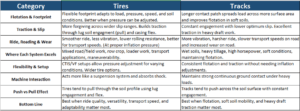
BKT USA, Inc.
Dave Paulk: Manager Field Technical Services
Contact pressure, footprint size, ground area and the degree of soil deformation are all results of the impact of tires or tracks on the soil, and are strictly related to the specific design of products, but also highly influenced by other factors, such as the load they carry and the conditions of ground contact. In the next paragraphs, we will discover how tires and tracks act differently in fields, according to specific soil conditions, and applications.
Main differences between Track & Tires
Tracks have a larger footprint area spreading the load more evenly, that creates a smoother contact surface and reduces the soil disturbance. This specific feature allows for a better distribution of load and pressure on a wider footprint, being synonymous with reduced compaction. Also, their improved flotation and a reduced risk of slippage ensure better performance even in wet, muddy or clay soil conditions.
Focusing on tires, the inflation pressure plays an important role, as can be adjusted and regulated to reduce ground-bearing pressure. In dry, sandy, and loamy soils, tires operating at lower air pressures have an increased footprint area on the ground: this translates to reduced compaction, crop preservation and improved soil productivity.
Slippage
The optimal slip range for most MFWD and 4WD tractors is 6–12%. A very low slip indicates that the tractor is underloaded and not operating at maximum tractive efficiency. While if slip becomes excessive, tractive efficiency decreases, resulting in high soil compaction and disturbance.
Tracks generally operate at lower slip rates than tires, often in the range of 2–5% under field conditions, because their large uniform contact area helps distribute weight more evenly and minimize slippage. They are especially effective in wet, soft soils, where improved flotation is important. Tracks also perform well in demanding, high-pulling tasks such as tillage and planting.
Load Capacity
Soil compaction is primarily influenced by the machine’s total load.
Tire systems can minimize compaction by adjusting air pressure to match the required load capacity, improving weight distribution and reducing ground pressure.
Tracked tractors are generally heavier than their tire-equipped counterparts, resulting in higher loads. However, tracks maintain a consistent contact area with the ground. This fixed, extensive contact patch helps distribute the weight more evenly than tires.
Air pressure
Most tire-equipped tractors are lighter and rely on air pressure to determine the ground-bearing pressure on the soil. When tire pressures are reduced below 20 psi, the load is spread over a larger footprint, helping minimize soil compaction. When comparing the percentage of soil compaction between tires and tracks, tires operated at moderate pressures (around 25–35 psi) can perform similarly to tracks. However, at higher pressures (35 psi and above), tracks typically cause less soil compaction.
Yokohama TWS
YTWS AG Group: Mike Giordano, Norberto Herbener, Chris Neidert
There has always been discussion about what system is better, tires or rubber tracks. Both systems have their advantages and are not exclusive one to the other. Equipment type and size, field usage, soil type and condition and customer preference will play a role in what system is more convenient. Agriculture rubber tracks are part of an engineered undercarriage system designed mostly for high-power, high-weight agricultural machines operating in demanding conditions as it is a more expensive option.
Rubber tracks have been developed to:
- Support high machine loads.
- Offer the most consistent traction on uneven terrain.
- Improve surface load distribution.
- Maintain productivity in certain soil conditions.
- Deliver a smoother ride in very uneven soil conditions.
Rubber tracks and tire complement each other where operating margins become critical. When comparing same equipment, the buying and maintenance cost is higher for the rubber track version as more components are involved.
Rubber tracks perform best when:
- Soil bearing capacity is reduced, like higher moisture contents.
- Draft force is remarkably high, for example scrapper application.
- Machine stability is critical to the operation, fields with irrigation roots.
- Harvesting cannot be delayed due to soil with excessive high moisture.
In standard or mixed conditions, modern VF agricultural tires already deliver excellent performance and can adapt to different conditions. Plus, they are more versatile with equipment that changes uses, like field operation and roading, where inflation pressure can be adjusted to provide the best performance.
In agriculture, rubber tracks excel in three areas:
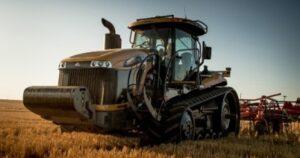
High-horsepower tractors
- Heavy draft operations
- Extremely high rear axle loads
- Frequent soft or wet soil exposure
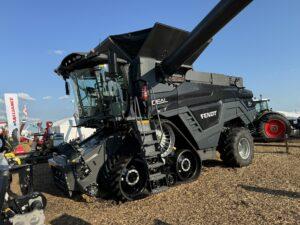
Large Combine Harvesters
- High static and dynamic load
- Wet harvest conditions
- Stability for wide headers
Steep Slopes
- Steep slopes and loose terrain
- High traction in tight working areas
- Reduced surface disturbance
Tires on the other hand allow a larger range of adaptation.
- Change inflation pressure to adapt to change in load.
- Equipment equipped with tires normally allows for higher speeds vs rubber track versions.
- Allow to change tread spacing for different crops.
- Accommodates Load Bonuses
Rubber tracks are not a universal replacement for tires, but an established technical solution for demanding agricultural applications. The optimal situation for rubber tracks is:
- High machine weight and torque
- Need for high traction
- Need for all season operation
- Loads are consistently heavy
- Soft or unstable running surface
- Sloped and uneven running conditions
All information is provided in this blog solely to provoke thought. All deductions made from information on this site must be confirmed by Certified Ag Tire / Track Dealer & Tire/Track Manufacturer before use. Ag Tire/Track Talk does not recommend anyone conduct tire service work with exception of Certified Ag Tire/Track Dealer Professionals.