Are Weak Hubs & Spindles Quietly Costing American Farmers Thousands?
AG Machinery Depot
Ethan Rod: Founder
For years, I’ve worked with agricultural hubs and spindles across Europe and the United States. What I’ve learned is simple:
Most downtime in heavy tillage equipment doesn’t start with the tire.
It starts inside the hub!
Many American farmers don’t realize that U.S. agricultural hub and spindle standards are generally lighter than European standards. That difference affects bearing size, load rating, seal quality, and long-term durability.
And when equipment runs harder, faster, and heavier than it was designed for — failure becomes inevitable.
A Short History: Where Heavy-Duty Hub Engineering Began
The foundation of modern heavy-duty hubs and spindles can be traced back to World War II.
European engineers, including those working on the Mercedes Unimog platform, were forced to develop axle systems capable of surviving:
- Extreme terrain
- High loads
- Military transport conditions
- Continuous operation
They redesigned hubs and spindles with:
- Larger tapered roller bearings
- Stronger forged spindle shafts
- Improved sealing systems
- Higher dynamic load capacity
That engineering philosophy carried into European agricultural machinery.
By the 1980s, tractors in Europe — especially those over 100 HP — were commonly built to operate at speeds exceeding 40 km/h (25 mph), with some reaching 50 km/h (32 mph). Higher speed requires stronger hub construction and larger bearing capacity to handle both dynamic load and heat.
Meanwhile, many U.S. agricultural machines remained built around 20 mph operational standards.
That difference still shows today.
The Hidden Cost of Downtime
In South Georgia, where we supply equipment and replacement components, we see the same problems repeatedly:
- Turbo till disk hubs failing mid-season
- Sunflower disk bearing overheating
- Utility equipment spindle fatigue
- Premature seal leakage
- 6-lug and 8-lug hubs wearing out too quickly
When a hub fails during planting or harvest, the real cost isn’t just the part.
It’s:
- Lost field time
- Labor expense
- Emergency repairs
- Equipment sitting idle
- Customer commitments at risk
Downtime during season can cost thousands — sometimes far more than the price difference between standard and heavy-duty components.
The Italian Standard: TVZ Hubs & Spindles
I am Ethan Rod, founder, with over 20 years of experience working with heavy-duty hub and spindle systems in Europe.
We now bring that same European engineering to the U.S. market through TVZ hubs and spindles — made in Italy.
These assemblies are built to European agricultural standards, which are significantly more demanding than typical U.S. specifications.
Larger Bearings – Higher Capacity
One major difference is bearing size.
TVZ hubs use significantly larger tapered roller bearings compared to average U.S. standard hubs.
For example:
-
Italian 6-lug hubs typically start at 7,800 lbs. to 9,000 lbs. load capacity
- Many U.S. standard 6-lug hubs are rated considerably lower
This matters because larger bearings mean:
- Reduced heat
- Lower internal stress
- Longer grease life
- Better load distribution
- Extended service intervals
TVZ hubs are engineered to carry up to three times the load capacity of many average U.S. standard hubs, depending on configuration.
Built for Harsh Agricultural Conditions
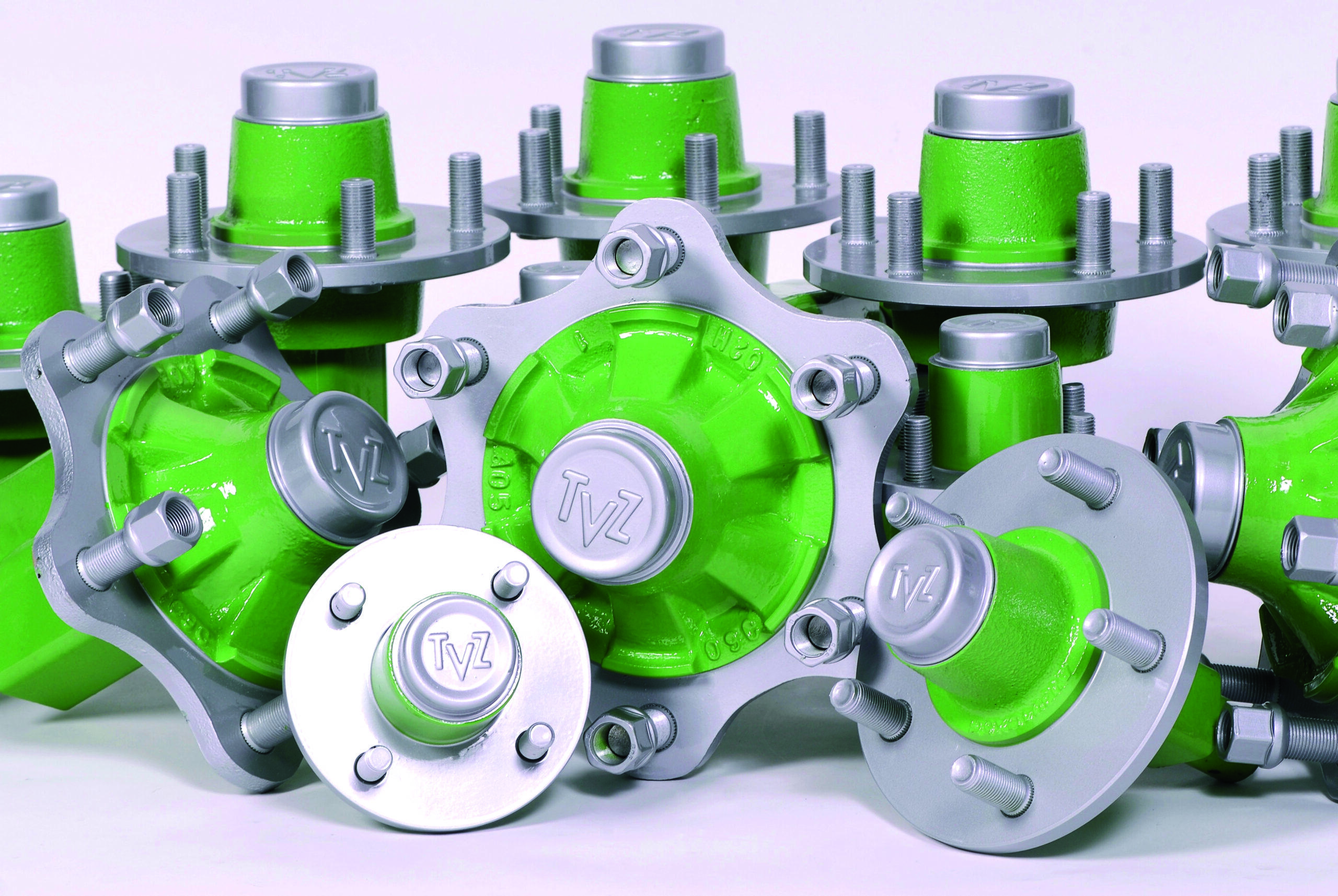
The TVZ hub assembly includes:
- Dual tapered roller bearings (30210 and 30213 series)
- NILOS protective rings
- Heavy-duty agricultural seal (065/120)
- M18x1.5 German-type studs
- M39 crown nut locking system
See technical assembly reference – Hub & Spindle Assembly, 6 Bolts
The seals are designed to withstand:
- Mud
- Water
- Dust
- High heat
- Continuous field vibration
Farmers who switch often tell us the same thing:
“For the first time, we’re not opening bearings every season.”
Complete System Solution: Reinforced Wheels & Tires
A stronger hub must be matched with the right wheel and tire.
We stock reinforced agricultural wheels and heavy-duty tires specifically designed to support higher load-rated hubs and spindles. The entire assembly — hub, spindle, wheel, and tire — works as a system.
Upgrading only part of the system often leads to imbalance.
We provide the complete reinforced solution.
5-Year Warranty
We stand behind the product with a 5-year warranty on TVZ hubs and spindles.
That means:
Install properly.
Grease correctly.
Run your equipment.
You shouldn’t have to touch the bearings year after year.
And any dealer who installs TVZ assemblies can confidently offer their customer that same peace of mind.
Why Farmers in South Georgia Are Switching
Over the past years, we have replaced numerous weak bearing and spindle setups throughout South Georgia.
After upgrading to Italian-built TVZ assemblies, farmers report:
- Dramatically reduced bearing failures
- No mid-season hub breakdowns
- No overheating
- Longer service life
- Greater confidence during peak season
When equipment is built to handle more than what you throw at it, reliability improves.
Final Thoughts
American farmers work some of the toughest soil and highest-load conditions in the world.
The question is simple:
Why use components built to lighter standards?
European heavy-duty hub engineering was developed under extreme conditions and refined through decades of high-speed agricultural use.
TVZ hubs and spindles offer:
- Made in Italy manufacturing
- European heavy-duty engineering
- Larger bearings than typical U.S. standard hubs
- Up to three times greater load capacity
- Reinforced wheel and tire compatibility
- 5-year warranty protection
Downtime is expensive.
Strength is an investment.
All information is provided in this blog solely to provoke thought. All deductions made from information on this site must be confirmed by Certified Ag Tire Dealer & Tire Manufacturer before use. Ag Tire Talk does not recommend anyone conduct tire service work with exception of Certified Ag Tire Dealer Professionals.