
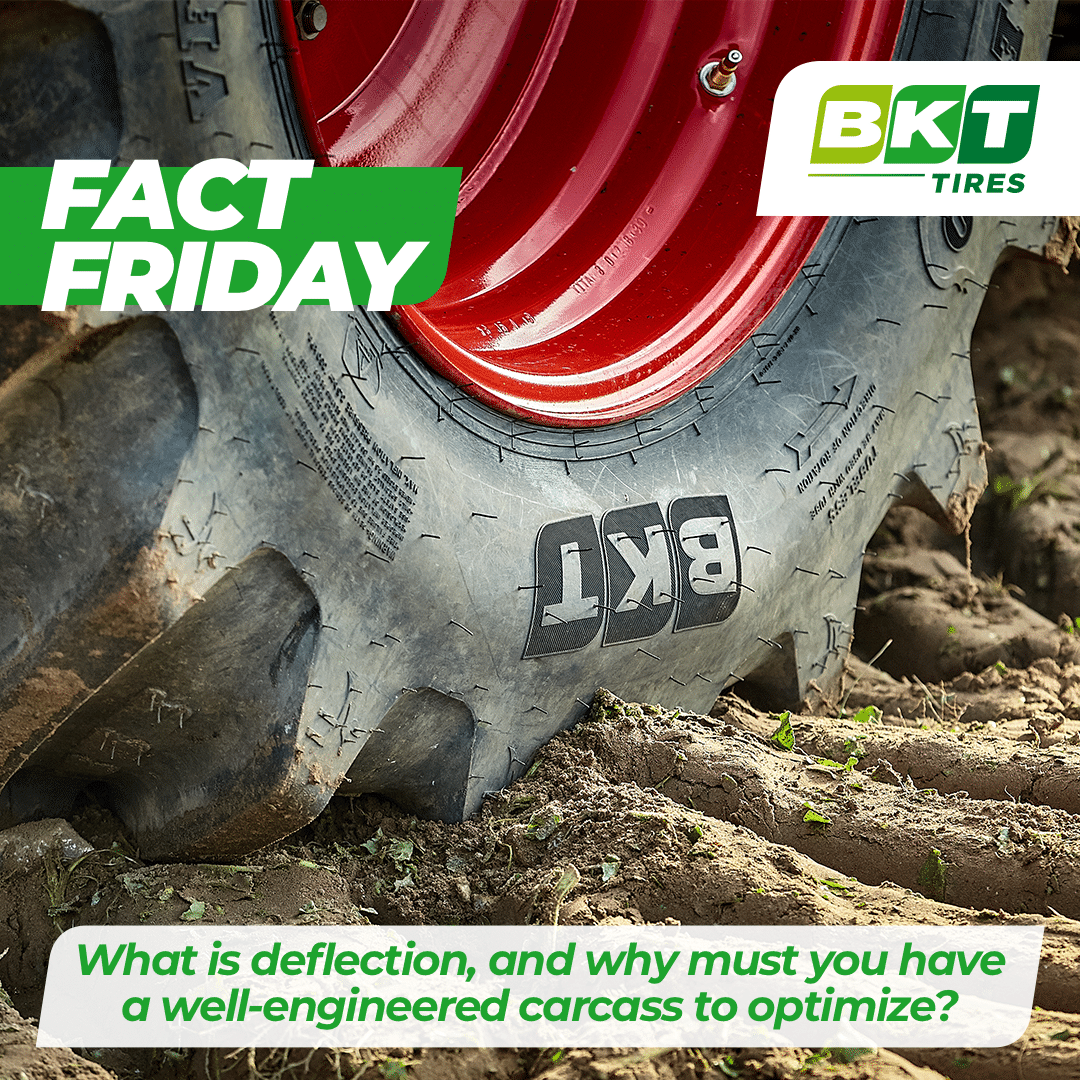
Deflection refers to the tire’s ability to flex under load and torque, and it can be observed as a sidewall bulge near the tire’s base. In particular, especially when it comes to radial tires, some deflection is essential to ensure good contact with the ground, resulting in improved stability and handling. Among the most relevant advantages of correct tire deflection, there’s a larger and more uniform tire footprint, which distributes the equipment’s weight evenly, thus reducing ground pressure and soil compaction, with positive effects in terms of crop yields, but not only, as it translates into optimized traction and fuel efficiency.
Another key advantage of proper sidewall deflection is related to improved ride comfort and operator comfort, as it allows the tire to flex and absorb impacts from bumps.
It is important to underline that a tire carcass must be properly designed to withstand tire deflection: in fact, cyclic flexing and compression generate heat, which may cause damage to the tire. This explains why maintaining the correct air pressure is crucial to help the tire dissipate heat effectively during operation and prevent excessively low pressure conditions that may lead to excessive heat buildup and tire failure.