
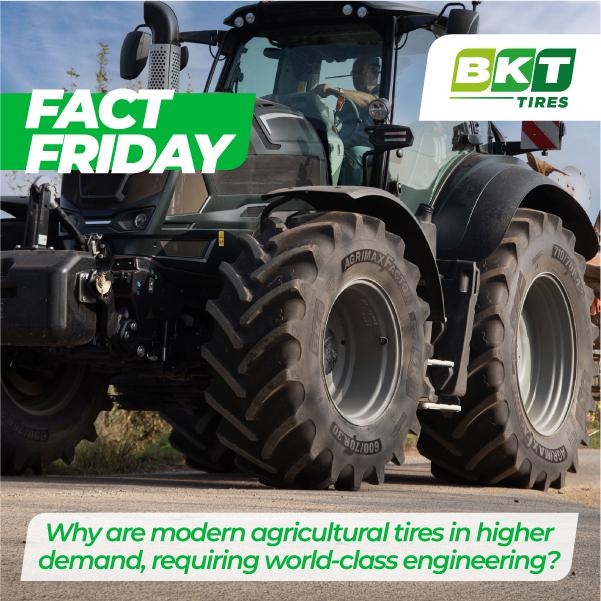
Modern agricultural tires must be built to meet the rising demands of modern agricultural equipment. Indeed, tractors are becoming faster and more powerful, making them larger and heavier, and able to operate across large field areas while meeting the rising food production needs.
Another key element to consider is that modern farms are more geographically dispersed than in the past, making speed even more important to minimize travel time between farm sites and improve efficiency. However, the modernization process concerns not only tractors but also agricultural tools such as self-propelled sprayers, harvesters, heavier implements (planters, chisel plows, cultivators, etc.), and other specialized equipment.
At the same time, no-till and minimum-till farming have become more prevalent in recent years. This has added another dimension to the demands on agricultural tires, as they are used at lower pressures to ensure larger footprints in the field that minimize soil compaction and improve traction, with positive results for agricultural yields.
This highlights the importance of supporting this evolution with more innovative tires and solutions, specifically designed to handle the increasing load capacities of heavier equipment and attached implements. For higher-horsepower tractors, additional weight is needed to transfer engine power to the ground, while at lower air pressures, tires must be capable of carrying these loads while maintaining low inflation pressures and operating efficiently in the field.
Also, tires need to be developed to handle higher speeds. While most MFWDs will run about 30 mph, there are tractors on the market that can run up to 45 mph. Tires must be designed and compounded to dissipate heat (the primary cause of tire degradation) at higher speeds on roads.
Last but not least, the latest cutting-edge solutions are equipped with precision agriculture systems, such as “Smart Tire” technologies, including integrated sensors and Central Tire Inflation Systems (CTIS), which are creating demand for technologically advanced tires.
As agricultural machinery continues to evolve, tire technology must keep pace with the industry’s changing requirements. From handling heavier loads and operating at higher speeds to protecting soil health and integrating with precision farming systems, modern agricultural tires are becoming increasingly sophisticated. More than ever, they play a crucial role in ensuring productivity, efficiency, and sustainability across today’s farming operations.