
QUESTION: What are the most popular Large AG Wheels, what is a bolt circle, center bore, offset, and what is knurling and purpose it serves?
AG TIRE TALK KEY TAKEAWAYS
ASCENSO: “There is more to an ag wheel than diameter and width. Rim contour, bolt circle, center bore, offset and bead seat all matter. A tire may physically fit on a wheel, but that doesn’t mean it’s the right wheel or that we’ll get the performance we should out of the tire.”
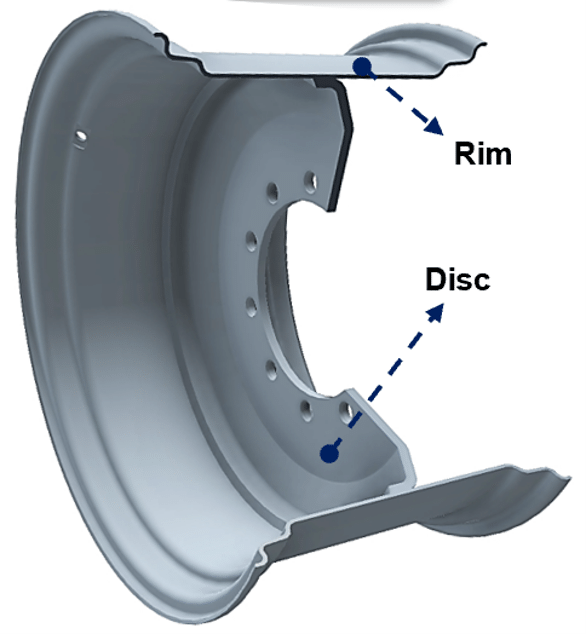
YOKOHAMA TWS: “Wheel definition = the Rim + Disk.”
MAXAM: “An agricultural wheel is defined by five core specifications: bolt circle, center bore, offset, rim contour, and knurling.”
BKT: “There are many agricultural wheel sizes currently used in the U.S. market- the most common large agricultural wheel diameters are 38″, 42″, 46″, 50″, and 54″.
Yokohama TWS
YTWS AG Group: Mike Giordano, Norberto Herbener, Chris Neidert
Trelleborg, tires which is part of Yokohama-TWS, is a leading supplier of high-quality wheels for a wide range of Agricultural, Forestry and Construction equipment. The investments made over the years in production, combine state of the art design with world class manufacturing, with the objective of making your working operations more efficient and productive. Trelleborg builds wheels from 3” to 54”. In this article we will be talking about ag wheels.
An agricultural wheel is a strongly constructed metal rim and disc assembly built for farm equipment.
Wheel definition = the Rim + Disk.
Popular large ag wheel sizes:
15×50 which fits a 480/80R50 tire.
16×42 which fits a 480/80R42 tire.
16×46 which fits a 480/80R46 tire.
15×34 which fits a 420/85R34 tire.
Popular SPRAYER wheel sizes:
25×46 this fits several sizes. VF750/60R46, IF710/65R46 tires.
20×38 this fits 650/65R38 tire.
13×50 this fits VF380/105R50 tire.
13×46 this fits a VF380/90R46 tire.
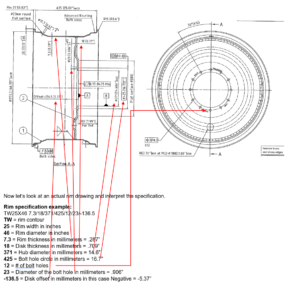
Let’s look at some definitions of the parts of a wheel. These specifications are very important to consider for the manufacturing process. We will look at some actual specifications later in the article but right now, below are the definitions of the anatomy of a wheel.
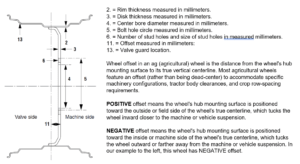
Why Offset Matters for Ag Equipment Clearance:
Proper positive offset ensures tires clear frame rails, steering components, and suspension parts.
Load Distribution: Correct alignment reduces excessive bearing wear caused by improper wheel positioning.
Reversibility: Some agricultural wheels are reversible or feature specific positive/negative configurations to alter row spacings or track widths.
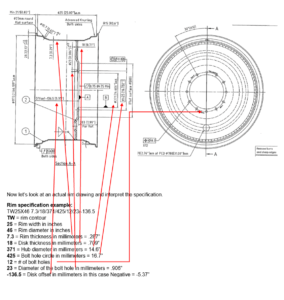
Our example wheel diagram above has a FORMED disk. Trelleborg uses FORMED disks.
Why Formed Disks are Stronger:
A formed disk is stamped or pressed into a 3D shape, giving it curves, ridges, or a “bowl” profile.
Better Stress Distribution: The curves and bends act like structural arches. When a heavy tractor turns or hits a bump, a formed disk spreads those harsh forces across the entire wheel rather than letting them focus on one single spot.
High-Speed Stability: The 3D geometry reduces structural flex and wobble, making formed wheels safer and longer-lasting for high-speed road travel under heavy loads.
Resilience to Side Loads: Ag equipment faces intense side-to-side (lateral) pressure during off-road work. Bends in the steel naturally resist bending forces much better than a completely flat piece of metal.
BKT USA, Inc.
Dave Paulk: Manager Field Technical Services
A. There are many agricultural wheel sizes currently used in the U.S. market. The most common large agricultural wheel diameters are 38″, 42″, 46″, 50″, and 54″.
DW20B × 38’’: Typically used with 650/65 R38 tires and commonly found on mid-size tractors and row-crop tractors.
DW16L × 42’’: Typically used with 520/85 R42 tires and commonly fitted on large row-crop tractors and combines, especially in dual-wheel configurations.
W12 × 46’’: Typically used with 380/90 R46 tires and commonly found on row-crop tractors and high-horsepower tractors.
W13 × 50’’: Typically used with VF380/90 R50 tires and commonly fitted on self-propelled sprayers and large MFWD (Mechanical Front-Wheel Drive) tractors with dual or triple wheel configurations.
DW11 × 54’’: Typically used with VF320/105 R54 tires and commonly found on four-wheel steering tractors and large self-propelled sprayers.
B. Rim Contour: W vs DW
The primary difference between W and DW rim contours is that W stands for Single Well and DW stands for Double Well.
In general, DW rims facilitate easier tire mounting and demounting due to their double-well design. DW rims also typically feature a wider bead seat compared to standard W rim profiles, making them suitable for larger and wider tire sections.
W rims are generally used with narrow to medium section-width tires, while DW rims are commonly used with wider tires that require higher load-carrying capacity, such as VF (Very High Flexion) and CFO (Cyclic Field Operation) tires.
As a result, DW rims are more commonly found on modern high-horsepower tractors, sprayers, combines, and other agricultural equipment utilizing wide-section tires operating at lower inflation pressures.
Popular sizes:
- W12X46 – 380/90R46
- DW20BX38 – 650/65R38
- DW16LX50 – VF480/95R50
- DW11X54 – VF320/105R54 CFO
LB: Rim Contour.
These are 5° drop-center rim contours commonly used in agricultural implement applications.
They are typically available in 14″, 15″, and 16″ rim diameters, which are among the most widely used sizes for implement tires. The 5° drop-center design facilitates easier tire mounting and demounting while providing reliable bead seating for implement service applications.
Popular sizes:
- 6LB X 16 – 7.50-16SL
- 8LB X16 – 10.00-16SL
- 8LB X 15 – 9.5L-15SL
Flotation: AG Rim Contour.
These are 15° drop-center rim contours commonly used in agricultural flotation tire sizes.
They are typically available in 22.5″, 26.5″, and 30.5″ rim diameters. The 15° drop-center design comprises the minimum well envelope for tire mounting purposes.
Popular sizes:
- AG16.00 X 22.5 – 560/45R22.5
- AG20.00 X 26.5 – 650/55R26.5
- AG28.00 X 30.5 – 850/50R30.5
It’s recommended to verify rim hump position vs. bead width to prevent any interference during bead seating.
Meaning of 10AT X 15” Wheel – 10AT refers to the rim profile or rim contour. For further information on the AT contour, we must refer to the T&RA standard for specific dimensions.
And 15” refers to the nominal rim diameter of the specific tire size.
6-6” Bolt circle means 6 holes are used to mount this wheel to the machine & all 6 holes are equally located on a 6-inch circle diameter, or the BCD.
4 5/8” center bore – refers to the diameter of the center hole in the wheel that fits over the hub pilot of the vehicle or machine. This dimension must match the hub pilot size to ensure proper wheel fitment. If the center bore is smaller than the hub pilot diameter, the wheel will not fit onto the machine and cannot be mounted correctly.
1 1/8” offset – refers to the distance between the wheel mounting surface and the centerline of the rim.
In this case, the wheel’s mounting face is positioned 1 1/8 inches (1.125″) away from the rim centerline. The offset determines the wheel’s position relative to the machine and affects tire width, tire clearance, and overall fitment.
There are two types of wheel offsets: positive offset and negative offset. The required offset depends on the machine configuration and application requirements.
Maxam Tire International
Trevor Wilson: Marketing Specialist
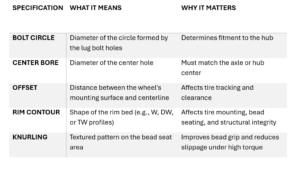
An agricultural wheel is defined by five core specifications: bolt circle, center bore, offset, rim contour, and knurling. This guide breaks down each specification, the most common large ag wheel categories, and how to read a wheel size designation correctly.
What Are the Most Popular Large AG Wheel Types?
Large agricultural wheels fall into three main categories, each built around a different tire and application: large ag drive wheels, implement wheels, and flotation wheels. Each category uses a distinct rim contour and bead seat design suited to how the tire on it needs to perform.
What Are W, DW, and TW Wheels and What Does the Well Do?
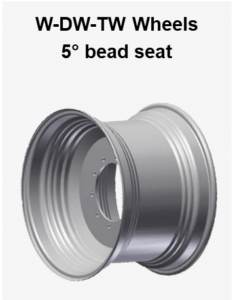
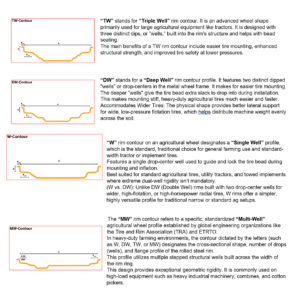
Large ag wheels are typically designated by their rim contour profiles—most commonly W (Wide Well), DW (Deep Well), or TW (Triple Well)—referring to the relief zone or well built into the rim bed.
The well exists to make tire mounting and demounting possible without damaging the tire beads. During mounting, the tire bead is pushed into the well, which provides the necessary slack to walk the opposite side of the bead over the rim flange. Without that relief zone, a stiff radial or bias ag tire bead could not be worked onto the rim by hand or with standard shop tools.
- W (Wide Well): A standard rim contour with a single drop well. Designed for lighter-duty or smaller-profile agricultural tires where standard bead slack is sufficient for mounting. Common sizes include W8 x 15, W10 x 15, and W12 x 16.5.
- DW (Deep Well): Features a deeper drop well profile that provides extra working room during mounting. DW contours are standard on larger row-crop and high-horsepower tractor drive tires with stiffer sidewalls and taller bead bundles. Common sizes include DW16 x 38, DW18 x 42, DW20 x 42, and DW23 x 42.
- TW (Triple Well): Designed with additional stepped relief zones across wide rim widths. TW profiles are specifically engineered for heavy-duty applications, high-capacity combine harvesters, sprayers, and wide VF/IF (Very High / Increased Flexion) tires where maximum bead relief is mandatory during installation. Common sizes include TW28 x 38 and TW30 x 42.
What Is an Implement Wheel and How Is It Different?
Implement wheels are engineered for towed equipment like grain carts, planters, manure spreaders, and tillage tools rather than the tractor itself. Implement wheel rim contours, often utilizing standard 5° drop-center or specialized heavy-duty W/DW profiles, are built around the vertical load profile of towed equipment rather than managing the continuous rotational drive torque and traction demands of a tractor wheel.
Popular implement wheel sizes cluster around standard light to heavy towed equipment hubs, ranging from smaller W8 x 15 and W10 x 15 sizes up through high-capacity DW16 x 30 or DW20 x 26 configurations for heavy planters and tillage tools.
What Is a Flotation Wheel and Where Is It Used?
Flotation wheels are built for wide, low-pressure flotation tires used on high-capacity equipment like self-propelled sprayers, floaters, and large grain carts where minimizing soil compaction and ground pressure matters more than narrow row-crop tracking. Flotation wheels utilize wide DW or TW rim contours engineered to support wide tire footprints and maintain uniform bead seating under heavy dynamic loads.
Popular flotation wheel sizes track closely with high-capacity flotation tire fitments, including heavy-duty profiles like DW27 x 32, DW30 x 32, and TW30 x 38.
How Do You Read an AG Wheel Size Designation?
In standard agricultural rim notation, size is expressed as Rim Width x Rim Diameter, preceded by the rim contour code. A wheel size designation string like DW10 x 15 with a 6 on 6-inch bolt circle, 4 5/8-inch center bore, and 1 1/8-inch offset provides all essential fitment specifications:
- DW10 x 15: The prefix DW indicates a Deep Well rim contour. The first number (10) is the internal rim width in inches. The second number (15) is the rim bead seat diameter in inches.
- 6 on 6-inch bolt circle: Six lug bolt holes arranged evenly on a circle with a 6-inch diameter.
- 4 5/8-inch center bore: The diameter of the center pilot hole, which must match the hub or axle pilot it mounts to.
- 1 1/8-inch offset: The distance between the wheel’s mounting plate surface and its true centerline, which determines tire clearance and machine track width.
Every one of these numbers must match the machine’s specifications. A bolt circle that is close but not exact will not mount. An incorrect offset can cause the tire to rub against chassis components or alter axle load distribution.
What Is Knurling and What Purpose Does It Serve on an AG Wheel?
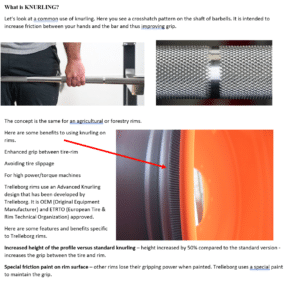
Knurling is a textured, ribbed pattern machined or rolled into the bead seat area of the wheel rim where the tire bead sits. Its purpose is to increase mechanical friction between the tire bead and the wheel, preventing the tire from slipping or spinning on the rim under high drive torque.
Without knurling, a high-torque application like a row crop tractor pulling a heavy load or working in high-draft conditions could cause the wheel rim to rotate inside the tire bead. This slippage leads to valve stem shearing, rapid air loss, and rim/bead wear. Knurling is critical on driven wheels carrying heavy rotational torque, whereas non-driven implement wheels generally do not require knurling.
Conclusion
Bolt circle, center bore, offset, rim contour, and knurling are the five specifications that determine whether an ag wheel fits correctly and performs reliably under field conditions. Reading a wheel size designation correctly before ordering prevents costly downtime and fitment errors.
Talk to your MAXAM dealer to confirm the right wheel specification for your machine and tire combination.
Ascenso Tires North America
Robert Bender: Product Manager & Tech Support—Off-Highway Tires
When we talk about ag tires, most of the conversation is around tire size, air pressure, load, traction and, more recently, IF and VF technology. What often gets overlooked is the wheel the tire is mounted on. The wheel is the other half of the equation.
There is more to an ag wheel than diameter and width. Rim contour, bolt circle, center bore, offset and bead seat all matter. A tire may physically fit on a wheel, but that doesn’t mean it’s the right wheel or that we’ll get the performance we should out of the tire.
The two most common rim contours on larger ag equipment are W and DW. A third, TW (triple-well), is becoming more common in the aftermarket.
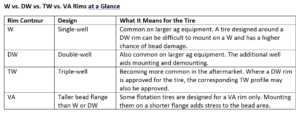
The W is a single-well design and DW is a double-well. The well, or drop, gives us room to mount and demount the tire. As we’re mounting the tire, the bead drops into the smaller diameter of the well and gives us enough room on the other side to get the bead over the flange. A DW gives us the additional well to aid in mounting and demounting, while TW takes that a step further with a triple-well profile. Where a DW rim is an approved rim for the tire, the corresponding TW profile may also be approved.
Rim Profile Example
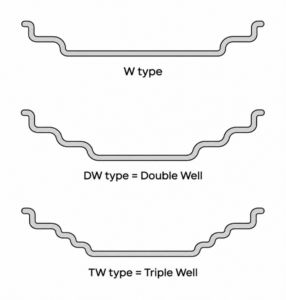
Using a different width can change the shape of the tire, how the bead seats and the amount of stress in the bead area. Mounting on the incorrect rim profile can also make the tire much harder to seat correctly. For example, mounting a high-load-index standard radial sprayer tire on a W rim can be difficult and increase the chance of bead damage when that tire is designed around a DW rim.
When we’re dealing with tires carrying more load, running lower air pressures and putting more horsepower to the ground, the wheel is an important part of making the whole package work correctly.
Wheel Measurement Basics
Wheel measurements matter just as much, so it pays to understand the basics.
Below is an example of a common implement wheel:
15″ x 10″
6-6″ bolt circle
4 5/8″ center bore
1 1/8″ offset
The 15″ x 10″ gives us the wheel diameter and width. The 15 inches is measured at the bead seat, not across the outside of the flange. The 10 inches is the nominal width between the bead seats.
The 6-6″ bolt circle means we have six mounting holes on a 6-inch bolt circle.
The 4 5/8″ center bore is the diameter of the center hole.
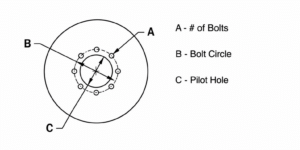
The 1 1/8″ offset tells us where the wheel sits in relation to the mounting surface.
Offset, inset and outset become especially important when we’re building custom wheels. Getting the bolt pattern right doesn’t do us much good if we put the tire in the wrong place on the tractor.
On a row-crop tractor, we may be trying to hit a specific row spacing. We need to know where that tire is going to sit once everything is mounted. We also need enough clearance from the tractor, axle, fenders and anything else around it.
I’ve dealt with plenty of custom wheel applications where these measurements become just as important as the diameter and width of the wheel itself.
When somebody says, “I need a 15 x 10 six-hole wheel,” there are still a couple more questions to ask.
Understanding the Bead Seat
The bead seat itself is another part of the wheel that’s easy to overlook. Several differences in bead-seat design can affect how the tire mounts, seats and performs.
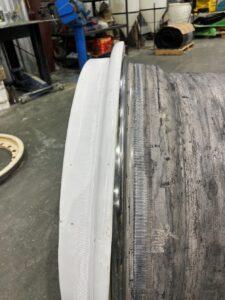
One of those features is knurling. Look closely at the bead seat on many larger ag wheels, especially ones designed for drive applications, and you’ll see ridges stamped or formed into the bead seat.
Knurling gives the tire bead something to grip, keeping the tire from slipping or indexing on the wheel. That grip matters more than ever with today’s horsepower and IF and VF tires running at lower pressures.
Flange height is another difference to watch. Some flotation tires are designed for a VA rim only, which uses a taller bead flange than a W or DW rim and will typically be multi-piece assemblies. That taller flange gives the bead the support it was designed around. Putting that tire on a shorter flange can add stress to the bead area and increase the chance of bead damage or failure. Always check the tire manufacturer’s rim contour guidelines.
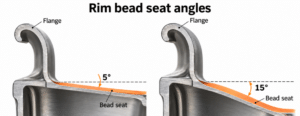
Then there is bead-seat taper. Many traditional ag wheels use a 5-degree bead seat, while we’ll also see 15-degree bead seats in flotation and other ag applications. The tire bead is designed around that angle, so we need to recognize the difference and match the tire size to the correct rim profile.
VF and NRO (Narrow Rim Option)
VF tires are another area where wheel width gets overlooked.
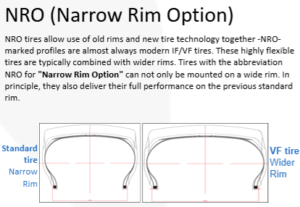
In most cases, the recommended rim for a VF tire is wider than the rim traditionally used on the same size standard radial. TRA and ETRTO guidelines show a narrower rim as an approved alternate, but that doesn’t mean we should assume the tire has the same performance or load capability on every approved rim.
Using a narrower rim reduces the volume of the air chamber. It also changes the shape of the tire and how the bead and casing work.
Recommended Wheel WIDTH = BEST Performance | AGTireTalk
That’s where NRO, or Narrow Rim Option, comes in.
An NRO VF tire is designed to run on a narrower rim than a standard VF tire of the same size would allow.
Within the Ascenso VF lineup, we have several common sizes offered both ways—standard VF and VF NRO—with the correct load and inflation tables for each.
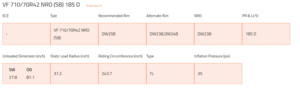
Look beyond the approved rim list to the recommended rim and the load and inflation table that goes with the tire.
Look at the Wheel While You’re There
Any time the tire is off, look the wheel over.
Look at the flanges, welds, center disc and bolt holes. On adjustable or multi-piece wheels, look at the hardware and mounting areas.
With multi-piece wheels, know exactly which components you’re working with. Parts that look similar aren’t necessarily interchangeable.
Loader tractors are one application where I pay particular attention to the wheel and hardware. Between the load, torque and constant changes in direction, they can be hard on wheel assemblies. Cracking around the mounting areas and hardware that isn’t staying torqued are things worth looking for.
We spend a lot of time making sure we’re putting the right tire on the tractor or implement. We should probably spend a little more time making sure we’re putting it on the right wheel.
All information is provided in this blog solely to provoke thought. All deductions made from information on this site must be confirmed by Certified Ag Tire Dealer & Tire Manufacturer before use. Ag Tire Talk does not recommend anyone conduct tire service work with exception of Certified Ag Tire Dealer Professionals.